India's first endoscopic vessel harvesting — and why it matters
March 12, 2026
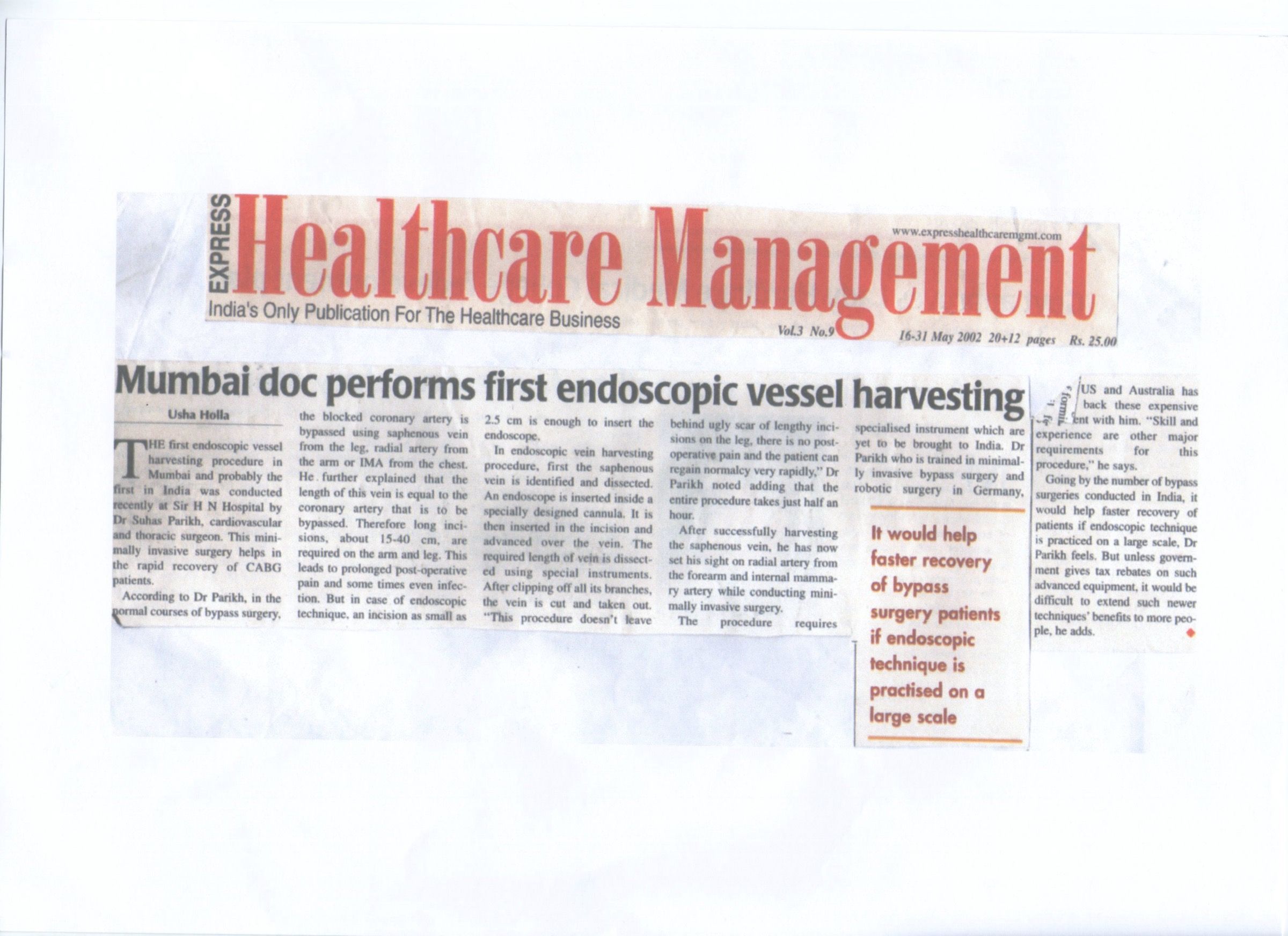
Every bypass operation has two wounds: the one on the chest that everyone thinks about, and the long incision on the leg — sometimes fifteen to forty centimetres — used to harvest the saphenous vein. For many patients, it was the leg, not the chest, that hurt longest, healed slowest and became infected most often.
A two-centimetre answer
Endoscopic vessel harvesting (EVH) changes this. Through a small incision of about two centimetres, with a camera and specialised instruments, the same length of vein is retrieved through a tunnel under the skin. When we performed the technique for the first time in India, at Sir H.N. Hospital in Mumbai in 2002, the change in our patients' recovery was immediate: less pain, dramatically fewer wound complications, earlier walking.
From first case to teaching faculty
The technique was later extended to radial artery harvesting, and teaching it to other surgeons — as faculty for the Ethicon Institute — became one of the most satisfying parts of my work. A first is only meaningful if it stops being a first.
What patients should ask
If you or a family member is scheduled for bypass surgery, ask how the vein will be harvested. Minimally invasive harvesting is now a standard of care a patient is entitled to ask about — and a good surgical team will be happy to explain its approach.